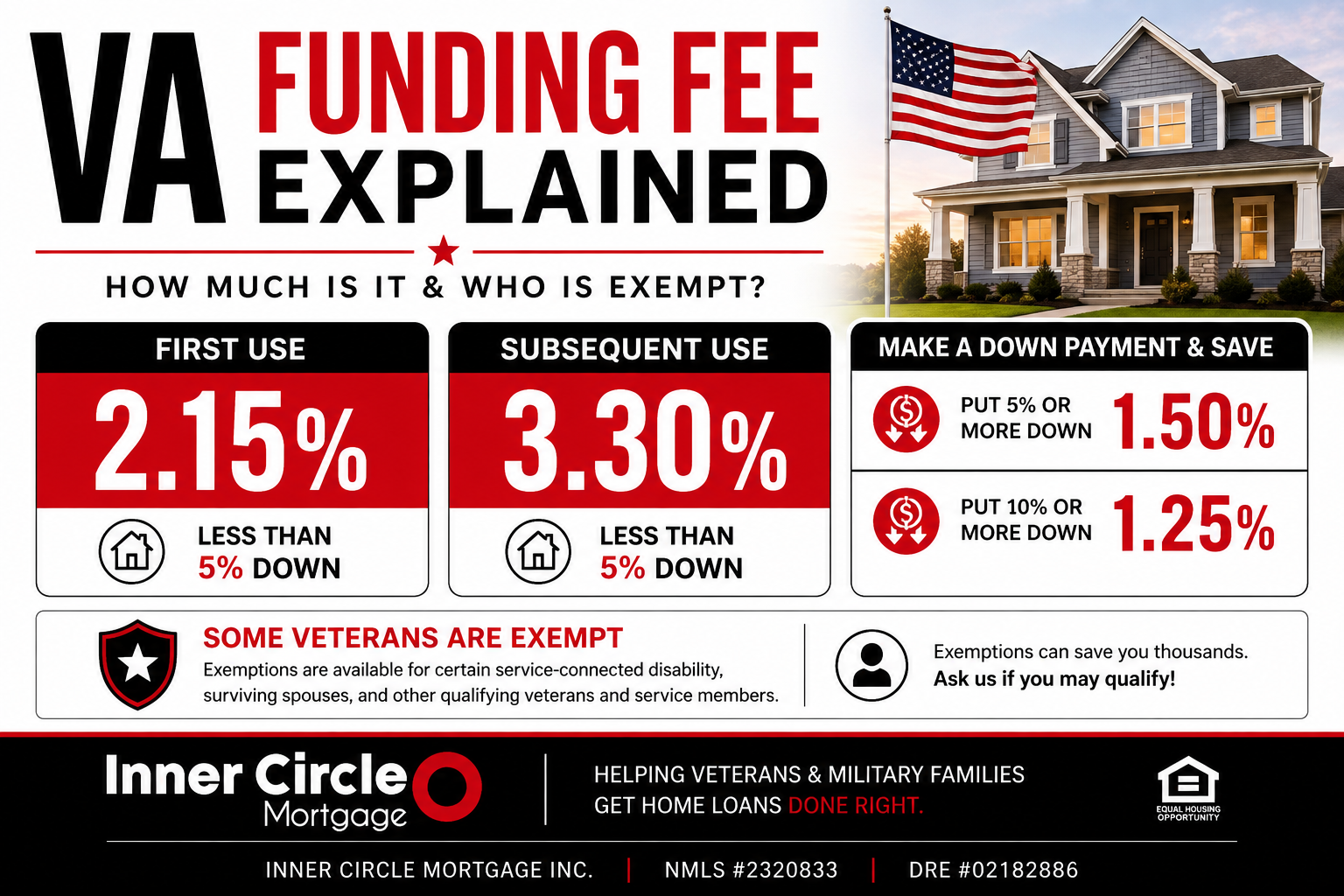
One of the biggest advantages of a VA home loan is the ability for eligible…
Conforming, High-Balance, and Jumbo Loans: What’s the Difference?
When comparing a conforming vs. jumbo loan, California homebuyers may also encounter a third mortgage category: the high-balance loan. Understanding the differences between conforming, high-balance, and jumbo loans can help you determine which financing option may be appropriate when purchasing a higher-priced home.
Although all three may be conventional mortgages, the differences can affect loan limits, available financing options, qualification requirements, and potentially the cost of borrowing.
The right loan category is generally determined by more than the price of the home. Your requested loan amount, the county where the property is located, the number of units in the property, your down payment, and your overall financial profile may all play a role.
Understanding these differences can help you compare your options and determine which type of financing may be appropriate for your home purchase. The conforming vs. jumbo loan distinction is important because two homes with the same purchase price could potentially fall into different loan categories depending on their locations, down payments, and final loan amounts. The conforming vs jumbo loan comparison below also explains where high-balance financing fits and why the applicable loan category may vary by location.
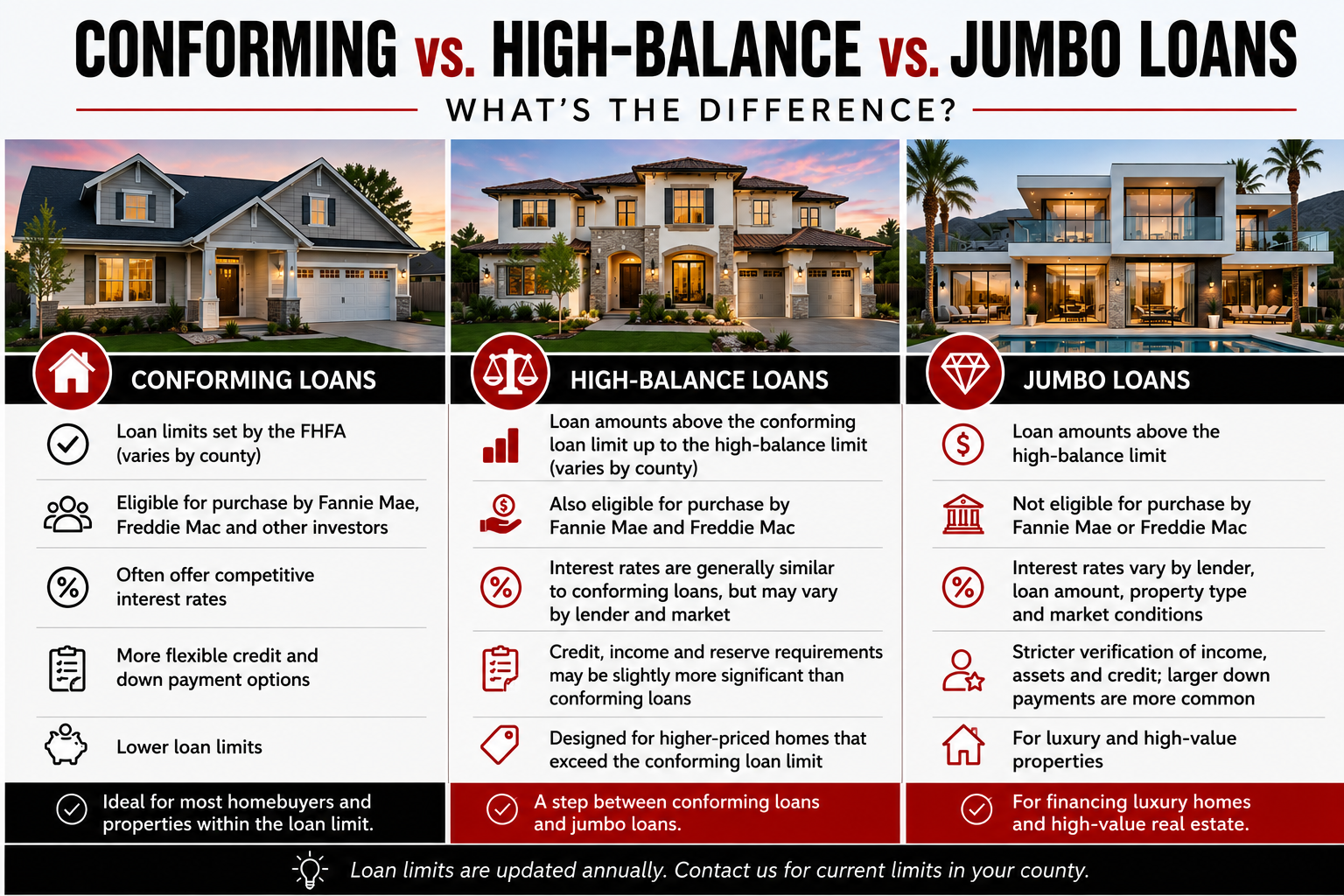
Conforming vs. High-Balance vs. Jumbo Loans: A Quick Comparison
| Loan Type | How It Generally Works | Loan Limit |
|---|---|---|
| Conforming loan | Meets applicable Fannie Mae or Freddie Mac eligibility requirements | At or below the standard conforming loan limit |
| High-balance loan | A conforming loan available in certain designated high-cost areas | Above the standard limit but within the applicable county limit |
| Jumbo loan | A conventional mortgage that exceeds the applicable conforming loan limit | Above the conforming limit for the property’s location |
What Is a Conforming Loan?
A conforming loan is a conventional mortgage that meets applicable eligibility requirements established by Fannie Mae or Freddie Mac, including limits on the maximum original loan amount.
Fannie Mae and Freddie Mac purchase eligible mortgages from lenders, which helps support liquidity and stability in the housing finance market. To qualify for purchase by either organization, a mortgage must meet applicable guidelines related to factors such as:
- Loan amount
- Credit history
- Debt-to-income ratio
- Property type
- Occupancy
- Loan-to-value ratio
- Income, employment, and asset documentation
The Federal Housing Finance Agency, commonly known as the FHFA, establishes conforming loan limits each year. The standard limit applies throughout most of the United States, while higher limits may be available in designated high-cost areas.
Because loan limits are updated annually, homebuyers should verify the current limit for the county where they plan to purchase.
What Is a High-Balance Loan?
A high-balance loan is a conforming mortgage that exceeds the standard conforming loan limit but remains within the higher limit established for an eligible high-cost area.
In other words, a high-balance loan occupies the space between a standard conforming loan and a jumbo loan.
High-balance loans may be available in counties where local home values justify a higher conforming loan limit. This is particularly relevant in California, where housing costs vary substantially between counties.
For example, a loan amount that requires jumbo financing in one county may potentially qualify as a high-balance conforming loan in another county with a higher applicable limit.
High-balance loans are sometimes called high-cost conforming loans. Freddie Mac also uses the term super conforming mortgage for eligible mortgages within higher loan limits in designated high-cost areas.
Although high-balance loans remain within the conforming mortgage system, some eligibility guidelines, pricing adjustments, and loan-to-value limits may differ from standard conforming loans.
What Is a Jumbo Loan?
A jumbo loan is a mortgage with a loan amount that exceeds the applicable conforming loan limit for the county where the property is located.
Because jumbo loans fall outside the standard conforming loan limits, they are not purchased by Fannie Mae or Freddie Mac through their regular conforming programs. Instead, individual lenders and investors establish their own jumbo-loan programs and underwriting requirements.
Jumbo financing is commonly used for higher-priced homes, but the purchase price alone does not determine whether a mortgage is considered jumbo. The requested loan amount is generally the key factor.
For example, a buyer purchasing a higher-priced home with a substantial down payment may still have a loan amount that falls within the applicable conforming or high-balance limit.
Jumbo loan programs can vary significantly. Depending on the lender and the borrower’s financial profile, options may be available with different down-payment requirements, fixed or adjustable interest rates, and alternative methods of documenting income or assets.
To learn more about available financing options, visit our Jumbo Home Loan page.
Conforming vs Jumbo Loan Options: Where Does a High-Balance Loan Fit?
The primary difference between a standard conforming loan and a high-balance loan is the maximum loan amount available for the property’s location.
A standard conforming loan generally follows the baseline loan limit established by the FHFA. A high-balance loan allows an eligible borrower to exceed that baseline amount when purchasing or refinancing a property in a designated high-cost area.
Both loan types remain conforming mortgages, but high-balance loans may have additional restrictions or different pricing considerations.
Depending on the loan program and transaction, differences may include:
- Maximum loan-to-value ratios
- Down-payment requirements
- Mortgage insurance options
- Property eligibility
- Reserve requirements
- Pricing adjustments
A high-balance loan is not automatically better or worse than a standard conforming loan. The appropriate option depends on the property location, loan amount, occupancy, down payment, and borrower qualifications.
High-Balance vs. Jumbo Loans
High-balance and jumbo loans are often confused because both can finance loan amounts above the standard conforming limit.
The key difference is that a high-balance loan remains within the higher conforming limit established for an eligible high-cost county. A jumbo loan exceeds the applicable conforming limit for that location.
This distinction may affect:
- Underwriting guidelines
- Available loan programs
- Interest rates and pricing
- Down-payment requirements
- Reserve requirements
- Appraisal requirements
- Income and asset documentation
Jumbo loans are not governed by one universal set of underwriting guidelines. Requirements may vary between lenders and investors, which can create additional financing opportunities for some borrowers.
Working with a mortgage broker may provide access to multiple lenders and jumbo loan programs rather than relying on the guidelines of a single bank.
Why Do Conforming Loan Limits Vary by County?
Housing costs vary significantly throughout the country. To account for these differences, higher conforming loan limits are available in certain areas where local home values exceed the national average.
The FHFA determines which areas qualify for higher limits and publishes updated conforming loan limits annually.
This is especially relevant in California because neighboring counties may have different loan limits. A buyer purchasing in one county may have access to high-balance conforming financing, while the same loan amount in another county may be considered jumbo.
Loan limits may also vary based on the number of residential units in the property. Limits for eligible two-, three-, and four-unit properties are generally higher than the limit for a one-unit home.
Because limits can change each year, it is important to review the current county-specific limit when evaluating a purchase.
Is the Loan Limit Based on the Home Price or the Loan Amount?
Conforming loan limits apply to the loan amount, not the purchase price of the property.
This distinction can be important for buyers purchasing higher-priced homes.
For example, two buyers could purchase homes for the same price but use different loan types because they make different down payments.
A buyer making a larger down payment may reduce the mortgage amount enough to qualify for conforming or high-balance financing. Another buyer purchasing a similarly priced home with a smaller down payment may require a jumbo loan.
The following factors may affect the loan category:
- Purchase price
- Down-payment amount
- Requested loan amount
- Property location
- Number of units
A personalized loan comparison can help determine whether adjusting the down payment creates a meaningful financial benefit.
Do Jumbo Loans Always Require a Larger Down Payment?
Not necessarily.
Jumbo loans are often associated with larger down payments, but requirements vary by lender, loan amount, property type, occupancy, credit profile, and other factors.
Some jumbo loan programs may allow lower down payments for well-qualified borrowers, while other programs may require more equity.
The lowest available down payment is not always the most cost-effective option. Buyers should also consider:
- Interest rate
- Monthly payment
- Mortgage insurance, if applicable
- Cash reserves after closing
- Long-term financial goals
- Available funds for investments, improvements, or emergencies
In some situations, using a jumbo loan and retaining additional cash may be preferable to making a larger down payment solely to remain under the conforming limit. In other situations, increasing the down payment may improve pricing or reduce the monthly payment.
The best option depends on the complete financial picture.
Do Jumbo Loans Have Higher Interest Rates?
Not always.
Mortgage rates are influenced by many factors, including market conditions, credit score, loan-to-value ratio, property type, occupancy, loan amount, and the specific lender or investor.
At times, jumbo mortgage rates may be higher than conforming rates. In other market environments, certain jumbo programs may offer competitive pricing.
High-balance loans may also have pricing adjustments that differ from standard conforming loans.
Rather than assuming one loan category will have the lowest rate, borrowers should compare the complete financing structure, including:
- Interest rate
- Annual percentage rate
- Lender fees
- Discount points
- Monthly payment
- Mortgage insurance
- Cash required at closing
The lowest advertised interest rate is not necessarily the lowest-cost loan.
Which Loan Type May Be Right for You?
When comparing a conforming vs. jumbo loan, the appropriate financing option depends on your requested loan amount, property location, down payment, financial qualifications, and long-term goals.
A standard conforming loan may be appropriate when the loan amount is within the baseline conforming limit.
A high-balance loan may be an option when the property is located in an eligible high-cost area and the loan amount exceeds the standard limit but remains within the county’s higher limit.
A jumbo loan may be appropriate when the requested loan amount exceeds the applicable conforming limit or when a specialized jumbo program better fits the borrower’s financial profile.
Before choosing a loan structure, it may be helpful to compare multiple scenarios. A mortgage broker can evaluate whether changing the down payment, loan amount, or financing program may improve the overall terms.
Frequently Asked Questions
Is a high-balance loan the same as a jumbo loan?
No. A high-balance loan remains a conforming mortgage within the higher loan limit available in an eligible high-cost area. A jumbo loan exceeds the applicable conforming limit for the property’s location.
Are all conventional loans conforming loans?
No. A conventional loan is generally a mortgage that is not insured or guaranteed by a federal government agency. Conventional loans may be conforming or non-conforming. Jumbo loans are generally considered conventional non-conforming mortgages.
Is a high-balance loan considered conforming?
Yes. High-balance loans remain within the conforming mortgage system but are subject to the higher limits available in designated high-cost areas.
Can a jumbo loan have a fixed interest rate?
Yes. Depending on the lender and program, jumbo loans may be available with fixed or adjustable interest rates.
Does the conforming loan limit apply to the purchase price?
No. The limit applies to the original loan amount rather than the home’s purchase price.
Do conforming loan limits change every year?
Conforming loan limits are reviewed and published annually by the FHFA. Limits may increase, remain unchanged, or vary based on property location and the number of units.
Are conforming loan limits the same throughout California?
No. Some California counties qualify for higher conforming loan limits because they are designated as high-cost areas. The applicable limit depends on the property location and number of units.
Can I make a larger down payment to avoid a jumbo loan?
Potentially. Because the applicable limit is based on the loan amount rather than the purchase price, increasing the down payment may reduce the mortgage into the conforming or high-balance range. Whether that strategy makes financial sense depends on the available loan terms and your broader financial goals.
Compare Your California Home Loan Options
Understanding the conforming vs. jumbo loan distinction—and where high-balance financing fits—can help you evaluate your available mortgage options.
Inner Circle Mortgage can compare multiple loan programs and help you understand how the applicable county loan limit affects your financing options.
Whether you are purchasing in Folsom, El Dorado Hills, Granite Bay, Roseville, Sacramento, or elsewhere in California, we can review your goals and provide loan scenarios based on your specific financial situation.
Contact Inner Circle Mortgage to discuss your home financing options or begin the preapproval process.
Loan programs, interest rates, eligibility requirements, and conforming loan limits are subject to change. This information is provided for educational purposes and is not a commitment to lend. Additional restrictions may apply.

Related Posts